


“If you’re a dreamer, come in,
If you’re a dreamer, a wisher, a liar,
A hope-er, a pray-er, a magic bean buyer…
If you’re a pretender, come sit by my fire
For we have some flax-golden tales to spin.
Come in! Come in!”
- Shel Silverstein, “Invitation” (Where the Sidewalk Ends, 1974)
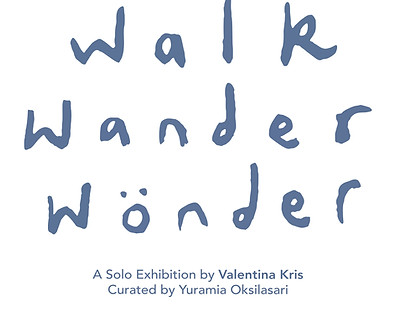
It was a lazy Sunday picnic in sunny Cigadung when Valentina first told me that she wanted to make her own exhibition. I was more than happy to welcome this light-hearted idea. I had known about her practice since 2022, when we first met in Bandung—my hometown, and a city she had just moved to at the time.
“Of what?” I asked. “Walking?”
It was my first guess, since I had noticed that she had been constantly making outfit-of-the-day collages since the beginning of 2025.
“A series!” she answered enthusiastically.
Then she asked me if I would help her navigate this Walk Series exhibition.
I was not immediately sure. Valentina and I can be quite different in how we see and respond to our mundane lives. But perhaps we are just two sides of the same coin: we walk differently, but we are both massive walkers.
And I had been hearing the stories behind her works for years anyway.
So, would I ever say no?
And just like that, we started walking.
Not literally, of course. We were still sitting at the picnic.
For Valentina, however, walking had started long before that Sunday.
It was another Sunday, almost two years earlier, when she made what she called her own declaration of independence. It came after some heebie-jeebies phases of life—journeys taken with other people, journeys that could not be continued, and eventually, a detour that she had to take on her own.
It was not exactly the most exciting route at first. But somewhere along the way, the detour became a small moment of liberation. To walk was to claim a little time for herself, to move at her own pace, and to choose where to go (or not). Bandung became the ground for this newfound freedom, at least after that Sunday.
Little by little, walking alone became less of an occasional activity and more of a ritual. It was a way to slow down and clear her mind in the middle of everyday urban life. Not by stepping away from the noise, but by walking right through it—while still keeping the time to herself. There was something comforting about being surrounded by people without having to be with anyone; to simply join the bustle of the city without having to take part in it.
And when you walk often enough, things start to repeat themselves. An outfit, a gesture, an object, or something she could not quite name. Some appeared only once; others returned again and again. A stranger could become a familiar face. A street could begin to carry a memory. Slowly, these small encounters gave character to the fragments of places she walked through.
There was a cycle to it: leaving, walking, noticing, arriving, returning. Then leaving again.
Somewhere in that cycle, walking became the Walk Series.
Walk: The City as Given
Walking may seem too ordinary an activity to require much thought. But looking at Valentina’s practice made me consider it as something beyond simply moving from one point to another. Our conversations eventually brought us to Michel de Certeau’s The Practice of Everyday Life, particularly “Walking in the City.”
De Certeau begins from an unusual position: 110 floors above Manhattan. From there, the city seems readable as a whole, with its streets, functions, boundaries, and systems. He then contrasts this view with the “ordinary practitioners” below: people who experience the city simply by moving through it, without ever seeing the whole picture.
This idea stayed with Valentina. The streets, sidewalks, and paths may already be there before we start walking, but we do not experience them in the same way. Our paths are also shaped by interactions, habits, memories, and simply by who we are. An extrovert and an introvert, she noted, may walk along the same sidewalk and have quite different experiences as a contrary movement.
This does not mean that people create a world from scratch. Rather, we negotiate with what is already there. De Certeau compares walking to a speech act: just as we use a language that we did not invent to say our own things, we also make our own use of the paths given to us. The city may provide the sidewalk, but it cannot fully decide how we walk through it.
For Valentina, Bandung is this given ground. As she walks, its paths collect encounters, observations, and memories that no plan could fully predict. Through the Urban Fabric brings some of these fragments together. Projected across layers of fabric, its visuals shift as visitors move. Another body enters, and what has been given is negotiated once again.
Wander: The City as Experienced
Wandering can begin with something as simple as choosing what to wear. Clothes, especially shoes, affect Valentina’s comfort, pace, and willingness to go further. But an outfit can also become a way of choosing how she wants to enter the city that day. The Valentina who walks through Bandung does not have to be exactly the same every time.
Her walks usually have a destination, but there is almost always a Plan B. With a phone and digital maps as support, she feels comfortable changing direction, taking another path, or staying somewhere longer. Having a destination, for her, does not mean deciding everything that happens in between.
What she carries home is not a complete record of the journey either. De Certeau describes memory as a kind of “anti-museum”: it cannot be neatly located or stored. A walk may instead remain through scattered details—an image, a feeling, something seen briefly along the way. What began as a physical route can return later in a different form.
Valentina finds a particular excitement in this uncertainty. She compares it to being a child, when not knowing what comes next can be part of the fun. Practicing space, in this sense, repeats “the joyful and silent experience of childhood”. Perhaps this childlike curiosity also explains something about Valentina’s practice: its playfulness, and its comfort with things that do not quite follow the expected order.
The Fit and The Misfit brings these fragments into drawings and moving images. Outfits and observations from different walks are rearranged into Valentina’s visual world.
Wonder: The City as Imagined
Wondering often comes from seeing something familiar differently. For Valentina, walking the same streets again and again does not always make them easier to understand. Something that starts as fun can turn into curiosity, and sometimes into questions about herself that are harder to answer.
The process of developing this work eventually brought us to another reading: Shel Silverstein’s Where the Sidewalk Ends. Valentina was drawn to how his simple illustrations and absurd stories could lead to surprisingly serious thoughts. In Hector the Collector, things dismissed as worthless become someone else’s treasures; in One Inch Tall, a small shift in scale changes how the everyday is perceived. Rather than explaining the world, Silverstein seems to enjoy changing its rules.
This offered Valentina another way to approach feelings that were difficult to put into words. The end of the sidewalk did not seem so frightening anymore. Reaching the edge of something familiar does not necessarily mean being lost; it may simply require another way of seeing what comes next. Perhaps this is also why playfulness matters in her practice. A serious thought does not always need a serious form.
In Outlier, photographs from Valentina’s walks are printed onto fabric, while a life-size 3D-printed figure of herself stands among them. The city she once moved through is now present through fragments of her own choosing. The observer becomes part of the scene, surrounded by a world assembled from what she has seen along the way.
Now You are Walking Too!
By now, we have been following Valentina’s walks for quite some time. But an exhibition also has its own walkers. People enter, move around, stop, look, and eventually leave. So at some point, Valentina’s walk has to make room for someone else’s.
The Rest of the Walk begins from this point. Part playground and part reading nook, it is not meant to remain exactly as it was when the exhibition opened. Through workshops and other activities throughout the exhibition, new drawings, stories, and responses will gradually enter the space.
Perhaps this is why the title is phrased in the past tense, while the work itself is still happening. What happened after the walk cannot be fully decided beforehand. Valentina may have started this journey, but she does not have to be the one who finishes it.
Now you are walking too.
Exhibition Plan

Artwork
1. Through the Urban Fabric, 2025–2026
55-second looping video mapping, interactive camera and ultrasonic sensor, layered fabrics, 6 hand-painted FDM 3D-printed miniature sculptures modeled in Blender, 6 pieces of fragmented found objects.
Courtesy of the artist.
Bringing together found objects and layers of fabric, Through the Urban Fabric explores how a given space can be experienced from different perspectives. A looping video projection introduces moving images into this fragmented arrangement, creating an interplay between physical objects and projected visuals. As visitors move around the installation, they encounter different layers of the composition, reflecting the varied ways people experience the same urban environment.
2. The Fit and The Misfit, 2025–2026
Video on a 5-inch LCD monitor, 32 framed illustrations and collages (11 × 11 cm each).
Courtesy of the artist.
Since 2025, Valentina has been documenting her daily outfits and walking experiences through an ongoing project shared on Instagram (@geekgo_). In The Fit and The Misfit, Valentina transforms her walking experiences into a collection of illustrated characters, collages, and miniature sculptures. Drawing from her daily outfits and observations along the way, the work explores how clothing, mood, and memory shape different versions of herself. These playful figures bring together familiar details and unexpected combinations, reflecting the shifting identities she carries through the city.
3. Outlier, 2026
Eight suspended fabric prints from the Walk Series (250 × 60 cm each), half-scale (1:2) FDM 3D-printed sculpture modeled in Blender.
Courtesy of the artist.
In Outlier, seven suspended fabric prints bring together images collected throughout Valentina’s walks, surrounding a half-scale sculpture of herself. By placing her own figure among these fragments, the work shifts her position from observer to part of the scene. Familiar encounters are rearranged into an imagined environment, inviting a different perspective on the relationship between herself and the places she has explored.
4. What Happened After The Walk, 2025–2026
Original Walk Series collages (2025), reworked into character-shaped collages (2026), with additional works developed through exhibition activities.
Courtesy of the artist.
Beginning with Valentina’s original Walk Series collages from 2025, What Happened After The Walk takes shape through new iterations that follow the silhouettes of her characters. Presented within a space for reading, play, and participation, the installation continues to grow throughout the exhibition. Workshops and other activities invite visitors to contribute their own drawings and responses, extending the work beyond Valentina’s individual experiences.
Let’s Work Together
Get in touch so we can start working together.